Enterprise Landing Zone
Overview
A Cloud Landing Zone is the foundational cloud environment designed to provide governance, networking, security, identity management, monitoring, and operational controls required for deploying enterprise workloads securely and consistently.
In large organizations, cloud environments cannot be created randomly for every team or application. Without proper structure, organizations face challenges related to security, compliance, operational consistency, identity management, and scalability.
A Landing Zone solves these problems by establishing standardized cloud architecture patterns that all workloads must follow.
This architecture is commonly used in:
Banking and financial platforms
Healthcare systems
Government cloud environments
Enterprise SaaS applications
Multi-cloud and hybrid cloud deployments
Kubernetes-based enterprise platforms
Core Objectives of a Landing Zone
A properly designed Landing Zone helps organizations achieve:
Governance
Centralized policy enforcement
Standardized cloud resource management
Compliance controls
Tagging and auditing standards
Security
Identity federation and SSO
Network segmentation
Firewall and WAF integration
Secrets management
Role-based access control
Scalability
Multi-environment deployment
Shared cloud networking
Standardized infrastructure provisioning
Enterprise workload isolation
Operational Excellence
Centralized monitoring and logging
Automated deployments
Backup and disaster recovery
Observability and alerting
Architecture Layers
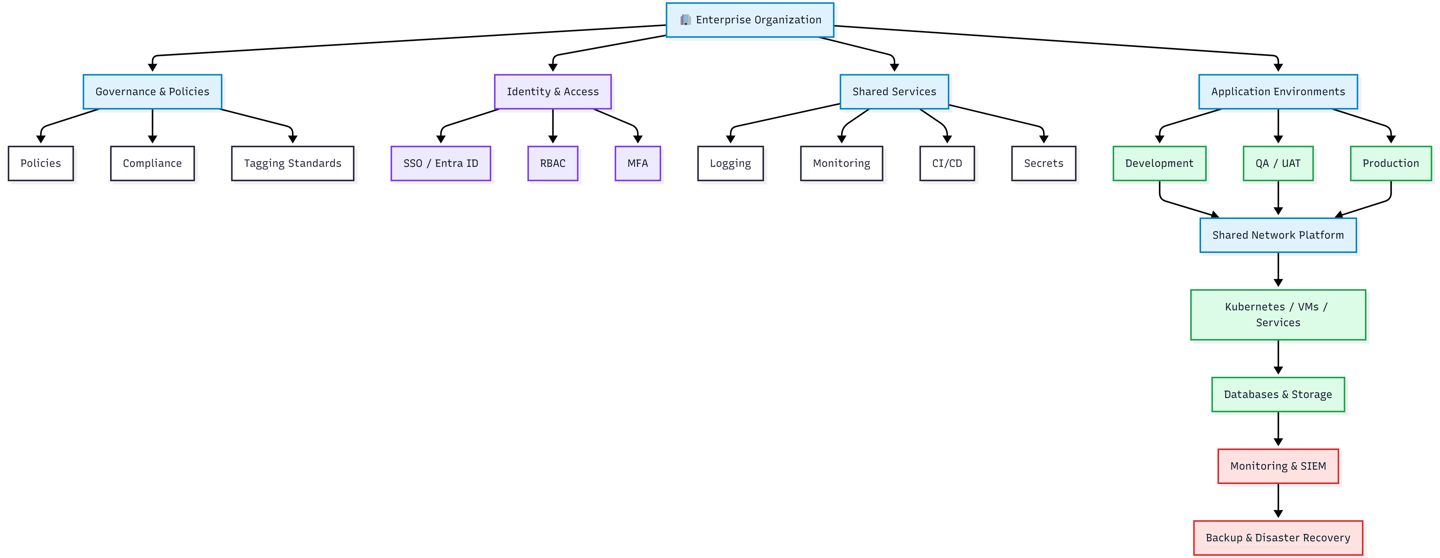
1. Organization & Governance Layer
The Organization layer acts as the top-level management boundary for cloud resources.
Responsibilities include:
Resource hierarchy management
Subscription or project organization
Policy enforcement
Billing and cost governance
Compliance auditing
Enterprise standards enforcement
This layer ensures that all cloud resources adhere to organizational governance standards.
2. Identity & Access Management Layer
Identity management is one of the most critical components of any enterprise cloud platform.
The Landing Zone integrates centralized identity providers such as:
Microsoft Entra ID
Active Directory Federation
Okta
Google Identity
Capabilities include:
Single Sign-On (SSO)
Multi-Factor Authentication (MFA)
Role-Based Access Control (RBAC)
Service accounts
Privileged Identity Management
Secrets and credential management
This enables secure and controlled access to cloud resources.
3. Shared Services Layer
Shared services provide centralized operational capabilities consumed across all environments.
Common shared services include:
Logging platforms
Monitoring systems
SIEM solutions
DNS services
Artifact repositories
CI/CD platforms
Security tooling
Backup services
Centralizing these services reduces operational duplication and improves governance.
4. Environment Segmentation
Enterprise environments are typically separated into:
Development
QA/UAT
Production
Benefits of environment isolation include:
Reduced blast radius
Independent deployments
Safer testing
Environment-specific security policies
Controlled release management
Each environment can operate independently while following centralized governance standards.
5. Shared Networking Architecture
A centralized networking architecture provides:
Shared VPC/VNet management
Controlled ingress and egress
Firewall enforcement
Secure workload communication
Private subnet segmentation
Connectivity to hybrid environments
Common networking patterns include:
Hub-and-Spoke networking
Shared VPC architecture
Transit networking
Hybrid cloud connectivity
6. Workload Platform
Enterprise workloads can run on:
Kubernetes platforms (GKE/AKS/EKS)
Virtual machines
Serverless platforms
Managed cloud services
Containerized applications
Applications communicate securely through private networking and internal service connectivity.
7. Monitoring & Observability
Modern cloud platforms require deep operational visibility.
The Landing Zone integrates:
Centralized logging
Metrics collection
Distributed tracing
Dashboards
SIEM integration
Alerting systems
Incident management workflows
Observability enables proactive monitoring and faster issue resolution.
8. Disaster Recovery & High Availability
Enterprise Landing Zones support resilient deployments through:
Multi-zone deployments
Multi-region architectures
Backup automation
Database replication
Failover routing
Standby environments
This ensures business continuity during infrastructure failures or regional outages.
Infrastructure Automation
Infrastructure provisioning should always be automated using Infrastructure as Code tools such as:
Terraform
Bicep
ARM Templates
CloudFormation
Benefits include:
Consistent deployments
Reduced manual errors
Faster provisioning
Version-controlled infrastructure
Repeatable environments
CI/CD pipelines integrate with the Landing Zone to securely deploy workloads into cloud environments.
Conclusion
A Cloud Landing Zone provides the foundational architecture required for securely operating enterprise cloud environments at scale.
By combining governance, networking, security, automation, monitoring, and operational standards, organizations can create scalable and resilient cloud platforms capable of supporting modern enterprise applications.
Get in touch
techgalari@gmail.com
☕ Enjoying TechGalary?
Support the creation of free technology guides, tutorials and open-source projects.