Enterprise API Gateway Architecture with Security Trust Zones
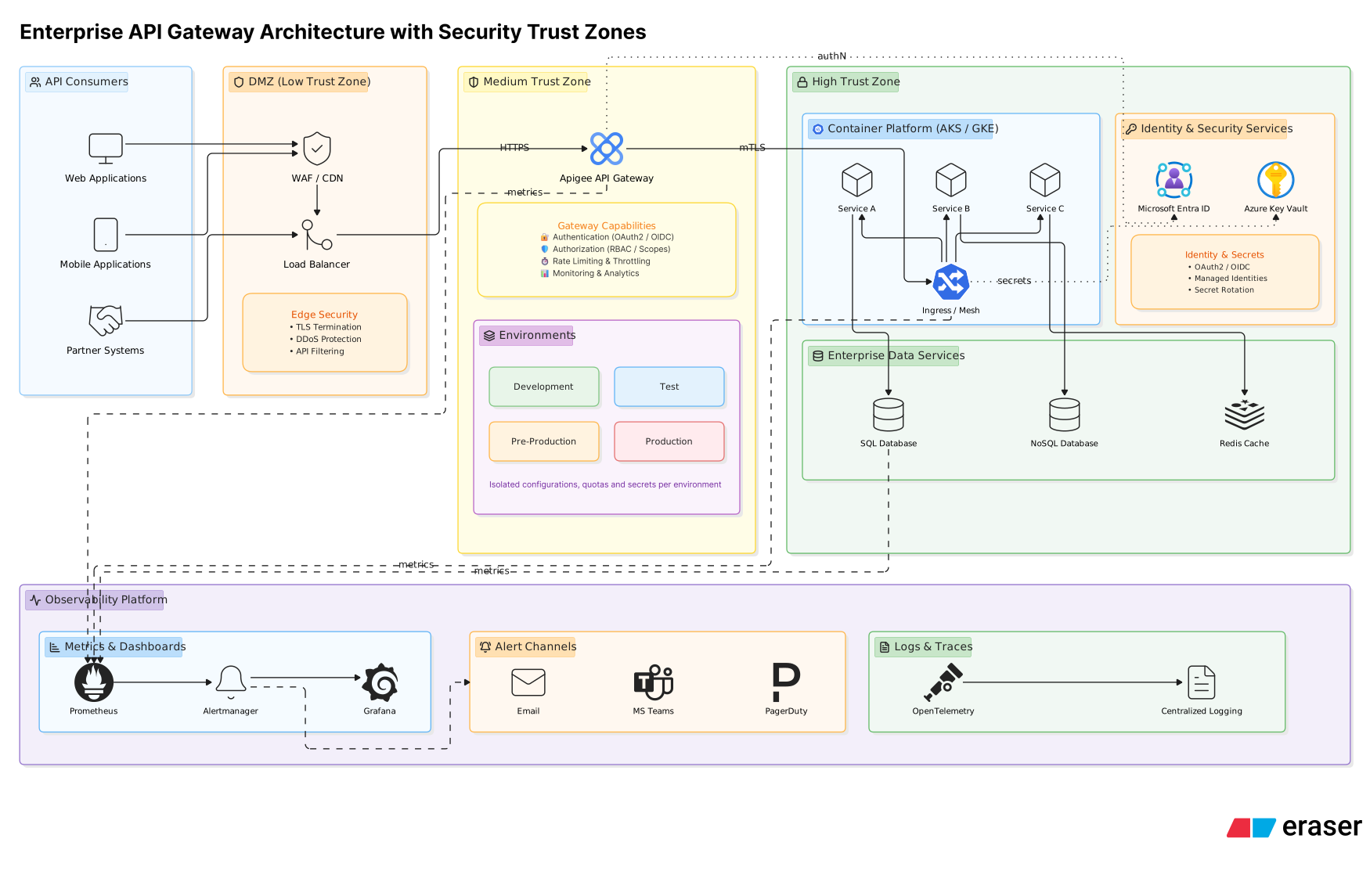
A practical look at designing an enterprise API platform using security trust zones, Apigee API Gateway, Kubernetes, centralized identity management, and observability. This architecture demonstrates how organizations can securely expose APIs while maintaining scalability, governance, and operational visibility.
Sowmya N
6/15/20262 min read
In most enterprise environments, exposing APIs is not as simple as putting an application behind a load balancer and making it accessible from the internet. Security requirements, regulatory controls, observability, and operational governance often require multiple layers of protection between consumers and backend services.
The following architecture demonstrates a common pattern used to securely expose APIs running on Kubernetes while maintaining clear trust boundaries and centralized operational controls.
Understanding the Request Flow
Every request starts with one of the consumers:
Web applications
Mobile applications
Partner integrations
Instead of allowing these consumers to communicate directly with backend services, traffic first enters a low-trust network zone.
DMZ Layer
The DMZ acts as the first security checkpoint.
In this layer, traffic passes through components such as a Web Application Firewall (WAF), CDN, and load balancer. These services help filter malicious requests, provide DDoS protection, and ensure only valid traffic reaches the internal platform.
At this stage, the goal is simple: stop bad traffic as early as possible.
API Gateway as the Control Plane
Once traffic passes the DMZ, it reaches the API Gateway.
In this architecture, Apigee is used as the centralized API management platform.
Rather than implementing authentication, authorization, rate limiting, and analytics separately in every application, these responsibilities are centralized within the gateway.
This provides a number of operational advantages:
Consistent security policies
Better API governance
Simplified monitoring
Improved developer experience
Over the years, I've found that centralizing these controls significantly reduces operational complexity, especially when the number of APIs begins to grow.
Environment Separation
One thing often overlooked in architecture diagrams is environment isolation.
Development, Test, Pre-Production, and Production environments should never be treated as a single shared platform.
Each environment typically maintains:
Independent configurations
Dedicated quotas
Environment-specific secrets
Separate deployment pipelines
This separation reduces deployment risk and makes troubleshooting significantly easier.
Identity and Secret Management
Applications should never store credentials inside source code or configuration files.
Instead, authentication and secret management are delegated to dedicated platform services.
In this architecture:
Microsoft Entra ID provides identity services.
Azure Key Vault manages secrets and certificates.
The Kubernetes workloads retrieve secrets dynamically when required, eliminating the need to distribute sensitive information across multiple systems.
Kubernetes Platform
The business services themselves run on AKS or GKE.
The diagram intentionally keeps the application layer simple with three representative services.
In reality, this could be dozens or even hundreds of microservices deployed across multiple namespaces.
Communication between services is protected using mTLS through the service mesh, ensuring that service-to-service traffic remains encrypted within the cluster.
Data Services
Not every workload has the same storage requirements.
That's why most enterprise platforms combine multiple persistence technologies.
For example:
Relational databases for transactional workloads
NoSQL databases for flexible, high-volume data
Distributed caches for low-latency access
Choosing the right storage technology for the workload is often more important than standardizing on a single database platform.
Observability
Operational visibility is often what separates a platform that looks good on paper from one that can actually be supported in production.
Metrics from the API Gateway, Kubernetes workloads, and supporting services are collected by Prometheus.
Alertmanager routes alerts to operational teams through channels such as Microsoft Teams, email, or PagerDuty.
Grafana provides a consolidated view of platform health, while OpenTelemetry and centralized logging solutions support troubleshooting and root cause analysis.
Without these capabilities, diagnosing issues in distributed systems becomes extremely difficult.
Final Thoughts
What I like about this architecture is that it addresses several common enterprise requirements without becoming overly complicated.
The design provides:
Clear trust boundaries
Centralized API governance
Secure identity integration
Kubernetes-based scalability
Enterprise-grade observability
While the technologies may vary from one organization to another, the architectural principles remain largely the same. Whether the platform runs on Azure, Google Cloud, or a multi-cloud environment, these patterns continue to be relevant when building secure and scalable API-driven systems.